
What ALTA's Latest Title Production Study Reveals About the Real Work Behind Every Closing: The AtClose Perspective
A closing may look simple from the outside. The buyer signs, funds move, documents are recorded, and ownership changes hands. But title professionals know how much work happens before that moment.
ALTA’s latest study, Measuring the Complexity of Title Production, makes that hidden work visible. It shows that title companies do far more than facilitate closings. They search records, identify risks, resolve defects, prevent fraud, coordinate payoffs, and help ensure buyers and lenders receive clear and insurable title.
That work is becoming harder to manage, especially for smaller teams. The study found that 73% of respondents employ 10 or fewer people, while 71% complete 75 or fewer closings per month. In other words, much of the title industry is made up of lean teams handling complex, high-stakes work with limited capacity.
Title Production Is Document-Heavy Work
The study confirms what operators already know: producing clean title requires careful review across many records and sources.
For purchase transactions, 61% of respondents reviewed 11 to 50 documents, while 21% reviewed more than 50. Even refinance transactions require substantial review, with 48% involving 11 to 50 documents.
These are not routine documents being checked for filing purposes alone. Title professionals review deeds, mortgages, liens, assessments, probate filings, easements, court records, tax records, name searches, and other public filings. Ownership and mortgage records were identified as the most difficult documents to review, followed closely by easements.
The implication is clear. Title work still depends on experienced judgment. Technology can help organize and move work forward, but it cannot replace the expertise required to interpret risk, resolve exceptions, and determine what must happen before closing.
Curative Work Is Central to Closing
The study also shows that curative work is not an occasional interruption. It is a core part of title production.
Nearly 60% of respondents reported removing three to five requirements or exceptions from the title commitment before closing. More than 20% had to clear six or more.
These requirements may involve prior mortgage releases, tax or judgment liens, HOA dues, deed errors, legal description issues, ownership discrepancies, probate matters, or gaps in the chain of titles. Each issue can slow down the file if the right information, document, approval, or party response is not available on time.
Payoffs add another layer of coordination. More than 66% of respondents obtained up to two payoffs, while 30% secured three to five. Mortgage payoffs were the most common obligation, followed by HOA dues and transfer fees.
For title teams, the operational challenge is not only knowing what needs to be cleared. It is coordinating the work required to clear it without losing visibility or momentum.
Fraud Prevention Is Now Everyday Work
Fraud prevention is no longer a one-time checklist. ALTA found that 52% of respondents spend at least 11 hours per month on anti-fraud measures, while nearly 15% spend more than 50 hours.
That reflects the growing risk environment around wire fraud, identity theft, forged deeds, seller impersonation, and other schemes that may not be visible through a public records search alone.
For title agencies, fraud prevention now must be woven into daily operations. It requires process discipline, clear documentation, timely review, and consistent follow-up across the life of the file.
The Operational Burden Is Really a Workflow Problem
The study does not simply describe more work. It describes more interconnected work.
Search and examination depend on multiple record sources. Curative work depends on outside parties, prior lenders, HOAs, sellers, underwriters, and public offices. Fraud prevention depends on constant attention to transaction details. Payoff coordination depends on timing, accuracy, and communication.
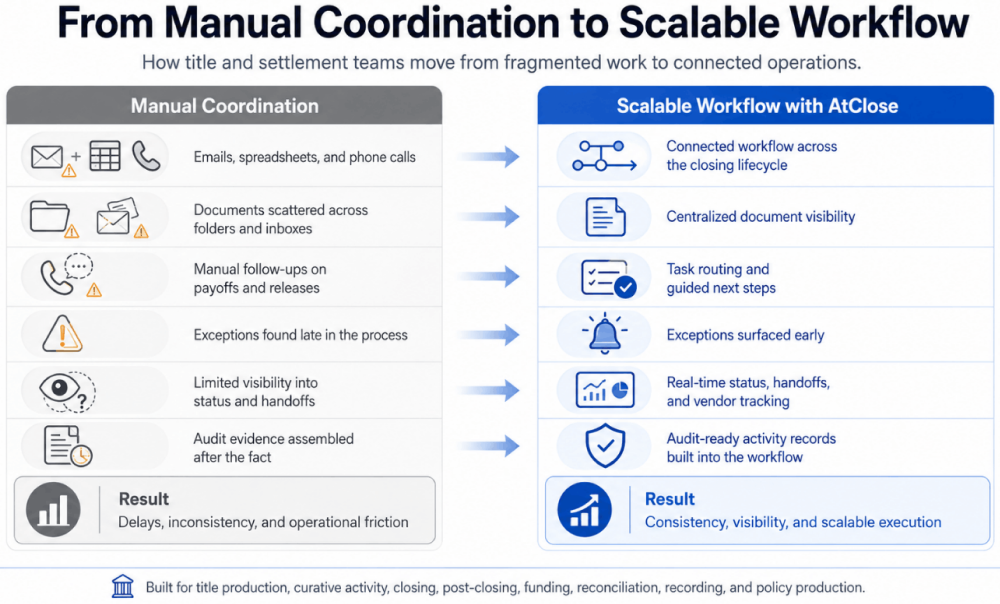
When this work is managed through scattered emails, spreadsheets, manual task lists, or disconnected systems, small delays multiply. A missing release, late payoff, unresolved exception, or unanswered vendor request can hold up the closing.
This is where automation can help, but only if it supports the real workflow. Basic task tracking is useful, but title teams need more than a place to store documents. They need systems that help route work, surface exceptions, standardize steps, monitor handoffs, and preserve audit-ready records as the file moves forward.
The AtClose Perspective
AtClose is designed around this operating reality. Title production is complex, document-heavy, and coordination-intensive. Human expertise remains essential, but teams should not have to spend so much time chasing updates, finding documents, manually routing tasks, or reconstructing file activity after the fact.
By supporting workflows across title production, curative activity, vendor follow-up, closing, post-closing, funding, reconciliation, recording, and policy production, AtClose helps title and settlement teams manage complexity with greater visibility and consistency.
The future of title production will not be defined by digitization alone. It will be defined by how well agencies can combine human expertise with scalable workflows.
ALTA’s study makes the real work behind every closing clear. The opportunity now is to protect that expertise, reduce administrative friction, and give title professionals the operational support they need to move files confidently toward close.