
FinCEN's Latest Real Estate Reporting Effort Signals a Shift for Title Agencies. Here's Why.
FinCEN’s Residential Real Estate Reporting Rule may currently be on hold, but title agencies should not mistake the pause for a change in direction. According to the official FinCEN Residential Real Estate Rule page, a federal court order has vacated the rule, FinCEN and the Department of Justice have appealed, and reporting persons are not required to file Real Estate Reports while the order remains in force.
Even so, the broader signal is clear. Residential real estate transactions are facing growing expectations around transparency, information collection, documentation, and oversight.
The rule is aimed at certain non-financed residential real estate transfers involving legal entities and trusts. ALTA’s FinCEN resource page explains that the reporting framework is designed around transactions involving residential real estate, purchases made without institutional lender financing, and at least one buyer or transferee that is a legal entity or trust.
For title and settlement companies, the significance goes beyond the legal details of one rule. It reflects a larger shift in what regulators, counterparties, and customers now expect from closing operations.
The Role of the Title Agency Is Expanding
Title agencies have always played a central role in getting transactions to the closing table. They coordinate parties, review documents, support title clearance, manage funds, and help ensure the transaction is completed correctly.
What is changing is the level of process discipline expected around that work.
Modern title operations increasingly require agencies to know who is involved in the transaction, confirm that required information has been collected, document key steps, coordinate across multiple parties, and preserve a clear record of activity.
This is not just a compliance issue. It is an operational issue.
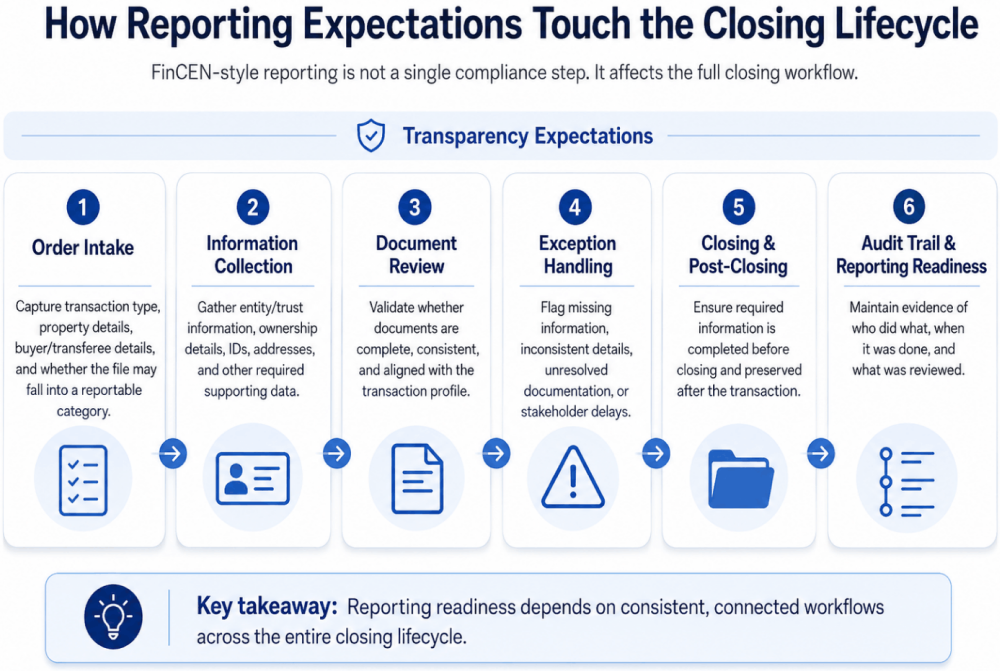
When a new reporting or information-collection requirement enters the workflow, it rarely affects only one step. It can influence intake, document collection, buyer and seller communication, lender coordination, internal review, exception handling, and post-closing records.
A missing data point or delayed response can quickly become a closing delay.
The Operational Burden Is Real
For many title teams, especially smaller agencies, the challenge is not understanding why compliance matters. The challenge is absorbing additional work without slowing down the entire operation.
A new reporting expectation creates practical questions: Who collects the information? When is it collected? Where is it stored? Who verifies that it is complete? How are exceptions handled? Can the agency prove what was done if the file is reviewed later?
If each answer depends on manual follow-up, scattered emails, or individual memory, the process becomes difficult to scale. It may work for a few files. It becomes risky when volume increases, staff changes, or transaction complexity rises.
That is why process consistency matters. Title agencies cannot rely on heroics every time a file becomes complicated. They need repeatable workflows that guide the team through required steps, surface missing information early, and create a reliable record of activity.
Technology Needs to Do More Than Store Documents
The FinCEN rule also highlights a practical technology question for title operations: is the system simply storing documents, or is it helping manage the work?
Document storage is useful. Task lists are useful. But reporting-driven workflows require more active orchestration. Teams need systems that can trigger the right steps, route work to the right person, flag incomplete information, support audit trails, and keep all parties aligned as the file moves forward.
This is where platforms like AtClose become relevant. AtClose supports title and settlement teams across the order lifecycle, from intake and title production to closing, post-closing, funding, reconciliation, recording, and policy production.
As expectations around transparency and oversight increase, connected workflows become more important. Compliance-related work cannot be treated as a separate layer added at the end. Information collection, documentation, review, and exception handling need to happen as part of the file’s normal movement toward closing.
Audit Readiness Is Becoming an Everyday Discipline
The larger industry shift is toward continuous readiness. Title agencies are being asked to demonstrate not only that a file closed, but that the work behind the file was complete, consistent, and traceable.
Even while the rule remains paused, the direction of travel is clear. Transparency expectations are increasing. Information collection is becoming more structured. Regulators are paying closer attention to real estate transactions involving entities and trusts. And title agencies are being pulled further into the front line of transaction oversight.
For title leaders, the practical takeaway is simple: preparation should not wait for regulatory certainty. The agencies best positioned for the future will be the ones that can adapt quickly, manage added requirements without disrupting closings, and maintain clear records across every file.
The future of title operations will not be defined by digitization alone. It will be defined by scalable workflows, consistent execution, and the ability to prove that the right work happened at the right time.