beyond
Blogs

Beyond the Waiting Game: How AI Tracks and Neutralizes Hidden HOA Landmines Before Closing

short desc
Ask any senior title processor about their worst closing day horror stories, and there’s a good chance an HOA is the main villain.

Ask any senior title processor about their worst closing day horror stories, and there’s a good chance an HOA is the main villain. Everything else on the file can be spotless: the title search is clean, the lender’s wire is queued, and the borrower is ready to sign their closing package. Then, twenty-four hours before funding, an unexpected surprise surfaces. An unrecorded architectural violation, a delinquent special assessment, or a ghost management company that refuses to return calls suddenly brings the entire transaction to a screeching halt.

In title and settlement operations, Homeowners Association (HOA) data is notoriously unpredictable. It remains one of the few stages where closing teams feel entirely at the mercy of third parties who operate on their own timelines. When an estoppel letter gets stuck in limbo, it isn’t just an administrative headache. It puts the lender’s interest rate lock at risk, burns out your escrow staff, and threatens client trust right before the finish line.

The Real Friction Behind HOA Estoppels

Why do HOAs create such disproportionate chaos in the closing workflow? The bottleneck is rarely just a slow clerk or a delayed mail delivery. It stems from structural inefficiencies across community management systems.

A recent industry article, 7 HOA Problems That Delay Closings (And How to Solve Them), outlines the specific operational landmines title teams face every week:

  • Ghost Contacts and Outdated Portals: Management companies merge or hand off accounts without updating public records, forcing processors to play phone tag with disconnected numbers.
  • Surprise Processing Fees: Estoppel fees vary wildly across jurisdictions, and many management groups demand upfront, non-refundable rush fees before opening a file.
  • Unrecorded Violations and Delinquent Dues: Outstanding fines for unapproved alterations or unpaid dues often go unmentioned until the formal certificate arrives—leaving no time to resolve disputes before closing.
  • Incomplete Documents: Some HOAs provide certificates that miss required statutory data or carry aggressive expiration dates that force expensive last-minute re-orders.

When teams rely on spreadsheets and manual phone calls to manage these variables, small oversights quickly turn into high-stakes fire drills.

The High Cost of the “Search and Hope” Model

For years, the standard approach to managing HOA estoppels has been simple persistence: assign a processor to call, email, and follow up repeatedly until a document appears. But in a modern closing environment, this brute-force method breaks down fast.

When processors spend hours playing detective just to locate a dormant management company or track down a $50 fee discrepancy, they aren’t working on complex curative issues or serving clients. They are acting as expensive administrative switchboards. Worse, because manual follow-ups happen reactively, critical delays are discovered late in the cycle. By the time a team realizes an HOA has gone silent, the buyer’s rate lock is expiring and everyone is scrambling to salvage the transaction.

Moving from Reactive Chasing to Proactive Validation

Fixing the HOA problem requires moving past static task lists and reactive email checking. Modern settlement teams are replacing manual lookup loops with intelligent document processing and automated workflow engines—the core capabilities powering platforms like AtClose to transform chaotic document intake into clean operational data.

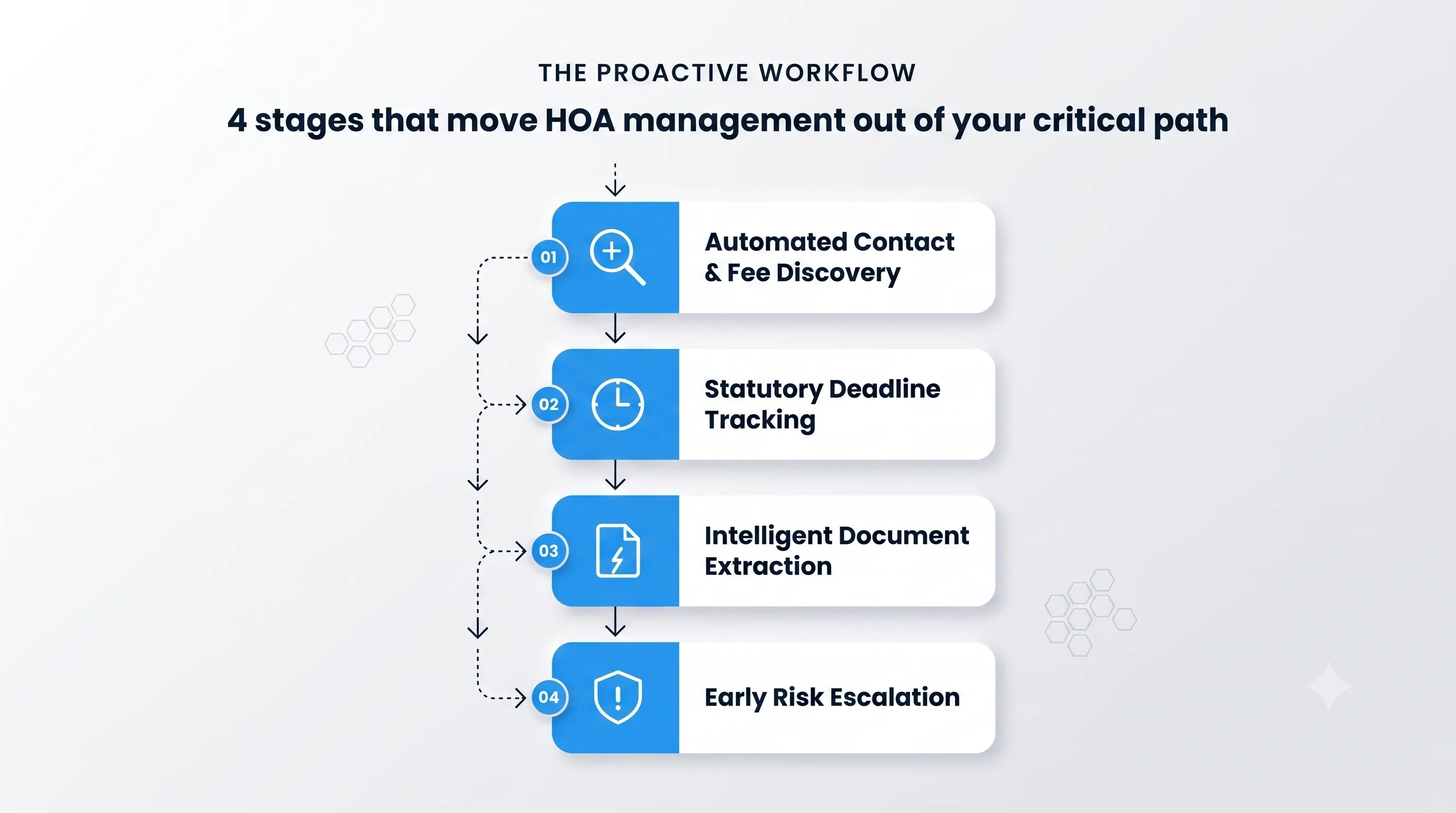
Instead of treating estoppels as an unpredictable waiting game, AI-driven automation builds proactive data validation directly into the order lifecycle:

  • Automated Contact and Fee Discovery: The system cross-references property addresses against verified databases, identifying correct contacts, required portals, and expected fee structures during order intake.
  • Statutory Deadline Tracking: Instead of relying on manual reminders, the platform calculates statutory response windows based on state rules and issues automated follow-ups to management companies.
  • Intelligent Document Extraction: The moment an estoppel certificate arrives, AI models analyze the document in seconds. The system extracts fee breakdowns, performs instant line-item reconciliation against expected figures, and flags unrecorded violations immediately.
  • Early Risk Escalation: If a management company misses a milestone or a document reveals a property violation, the system alerts the designated specialist right away. This gives your team days rather than hours to resolve the issue.


Protecting Margins and Relationships

Neutralizing HOA landmines isn’t just about avoiding last-minute stress; it directly drives operational profitability. By stripping out the manual friction surrounding HOA tracking, title agencies achieve higher file throughput without overloading their staff.

More importantly, proactive HOA management protects your reputation with key referral partners. Lenders and real estate agents notice when an agency consistently delivers smooth, on-time closings without eleventh-hour surprises. Eliminating uncertainty from third-party requests transforms your team from reactive paperwork processors into trusted strategic partners.

Clear the Path to the Closing Table

The hidden landmines in HOA estoppels don’t have to dictate your daily closing schedule or disrupt your operational margins. Combining intelligent document capture with automated workflow orchestration allows your team to catch exceptions early, protect lender timelines, and deliver a predictable settlement experience every single time.

Ready to take control of your closing pipeline and eliminate manual chasing? Explore how AtClose brings intelligent automation to your title operations today.

estate
Blogs

FinCEN's Latest Real Estate Reporting Effort Signals a Shift for Title Agencies. Here's Why.

short desc
A closer look at how transparency expectations are reshaping closings

FinCEN’s Residential Real Estate Reporting Rule may currently be on hold, but title agencies should not mistake the pause for a change in direction. According to the official FinCEN Residential Real Estate Rule page, a federal court order has vacated the rule, FinCEN and the Department of Justice have appealed, and reporting persons are not required to file Real Estate Reports while the order remains in force.

Even so, the broader signal is clear. Residential real estate transactions are facing growing expectations around transparency, information collection, documentation, and oversight.

The rule is aimed at certain non-financed residential real estate transfers involving legal entities and trusts. ALTA’s FinCEN resource page explains that the reporting framework is designed around transactions involving residential real estate, purchases made without institutional lender financing, and at least one buyer or transferee that is a legal entity or trust.

For title and settlement companies, the significance goes beyond the legal details of one rule. It reflects a larger shift in what regulators, counterparties, and customers now expect from closing operations.

The Role of the Title Agency Is Expanding

Title agencies have always played a central role in getting transactions to the closing table. They coordinate parties, review documents, support title clearance, manage funds, and help ensure the transaction is completed correctly.

What is changing is the level of process discipline expected around that work.

Modern title operations increasingly require agencies to know who is involved in the transaction, confirm that required information has been collected, document key steps, coordinate across multiple parties, and preserve a clear record of activity.

This is not just a compliance issue. It is an operational issue.

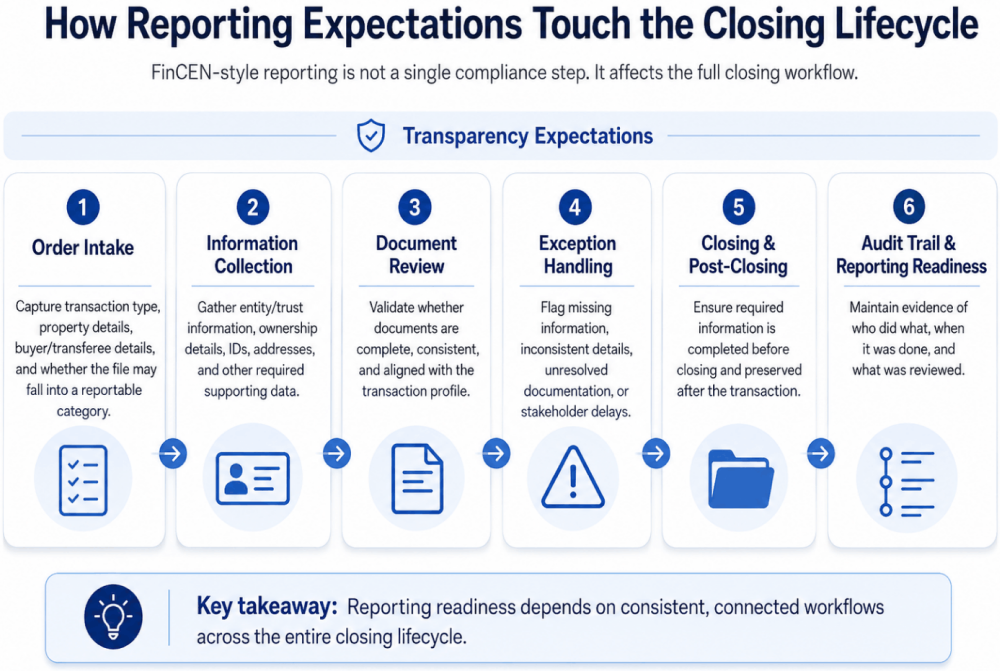
When a new reporting or information-collection requirement enters the workflow, it rarely affects only one step. It can influence intake, document collection, buyer and seller communication, lender coordination, internal review, exception handling, and post-closing records.

A missing data point or delayed response can quickly become a closing delay.


The Operational Burden Is Real

For many title teams, especially smaller agencies, the challenge is not understanding why compliance matters. The challenge is absorbing additional work without slowing down the entire operation.

A new reporting expectation creates practical questions: Who collects the information? When is it collected? Where is it stored? Who verifies that it is complete? How are exceptions handled? Can the agency prove what was done if the file is reviewed later?

If each answer depends on manual follow-up, scattered emails, or individual memory, the process becomes difficult to scale. It may work for a few files. It becomes risky when volume increases, staff changes, or transaction complexity rises.

That is why process consistency matters. Title agencies cannot rely on heroics every time a file becomes complicated. They need repeatable workflows that guide the team through required steps, surface missing information early, and create a reliable record of activity.

Technology Needs to Do More Than Store Documents

The FinCEN rule also highlights a practical technology question for title operations: is the system simply storing documents, or is it helping manage the work?

Document storage is useful. Task lists are useful. But reporting-driven workflows require more active orchestration. Teams need systems that can trigger the right steps, route work to the right person, flag incomplete information, support audit trails, and keep all parties aligned as the file moves forward.

This is where platforms like AtClose become relevant. AtClose supports title and settlement teams across the order lifecycle, from intake and title production to closing, post-closing, funding, reconciliation, recording, and policy production.

As expectations around transparency and oversight increase, connected workflows become more important. Compliance-related work cannot be treated as a separate layer added at the end. Information collection, documentation, review, and exception handling need to happen as part of the file’s normal movement toward closing.

Audit Readiness Is Becoming an Everyday Discipline

The larger industry shift is toward continuous readiness. Title agencies are being asked to demonstrate not only that a file closed, but that the work behind the file was complete, consistent, and traceable.

Even while the rule remains paused, the direction of travel is clear. Transparency expectations are increasing. Information collection is becoming more structured. Regulators are paying closer attention to real estate transactions involving entities and trusts. And title agencies are being pulled further into the front line of transaction oversight.

For title leaders, the practical takeaway is simple: preparation should not wait for regulatory certainty. The agencies best positioned for the future will be the ones that can adapt quickly, manage added requirements without disrupting closings, and maintain clear records across every file.

The future of title operations will not be defined by digitization alone. It will be defined by scalable workflows, consistent execution, and the ability to prove that the right work happened at the right time.

production
Blogs

What ALTA's Latest Title Production Study Reveals About the Real Work Behind Every Closing: The AtClose Perspective

short desc
The real closing work happens long before signatures

A closing may look simple from the outside. The buyer signs, funds move, documents are recorded, and ownership changes hands. But title professionals know how much work happens before that moment.

ALTA’s latest study, Measuring the Complexity of Title Production, makes that hidden work visible. It shows that title companies do far more than facilitate closings. They search records, identify risks, resolve defects, prevent fraud, coordinate payoffs, and help ensure buyers and lenders receive clear and insurable title.

That work is becoming harder to manage, especially for smaller teams. The study found that 73% of respondents employ 10 or fewer people, while 71% complete 75 or fewer closings per month. In other words, much of the title industry is made up of lean teams handling complex, high-stakes work with limited capacity.

Title Production Is Document-Heavy Work

The study confirms what operators already know: producing clean title requires careful review across many records and sources.

For purchase transactions, 61% of respondents reviewed 11 to 50 documents, while 21% reviewed more than 50. Even refinance transactions require substantial review, with 48% involving 11 to 50 documents.

These are not routine documents being checked for filing purposes alone. Title professionals review deeds, mortgages, liens, assessments, probate filings, easements, court records, tax records, name searches, and other public filings. Ownership and mortgage records were identified as the most difficult documents to review, followed closely by easements.

The implication is clear. Title work still depends on experienced judgment. Technology can help organize and move work forward, but it cannot replace the expertise required to interpret risk, resolve exceptions, and determine what must happen before closing.

Curative Work Is Central to Closing

The study also shows that curative work is not an occasional interruption. It is a core part of title production.

Nearly 60% of respondents reported removing three to five requirements or exceptions from the title commitment before closing. More than 20% had to clear six or more.

These requirements may involve prior mortgage releases, tax or judgment liens, HOA dues, deed errors, legal description issues, ownership discrepancies, probate matters, or gaps in the chain of titles. Each issue can slow down the file if the right information, document, approval, or party response is not available on time.

Payoffs add another layer of coordination. More than 66% of respondents obtained up to two payoffs, while 30% secured three to five. Mortgage payoffs were the most common obligation, followed by HOA dues and transfer fees.

For title teams, the operational challenge is not only knowing what needs to be cleared. It is coordinating the work required to clear it without losing visibility or momentum.

Fraud Prevention Is Now Everyday Work

Fraud prevention is no longer a one-time checklist. ALTA found that 52% of respondents spend at least 11 hours per month on anti-fraud measures, while nearly 15% spend more than 50 hours.

That reflects the growing risk environment around wire fraud, identity theft, forged deeds, seller impersonation, and other schemes that may not be visible through a public records search alone.

For title agencies, fraud prevention now must be woven into daily operations. It requires process discipline, clear documentation, timely review, and consistent follow-up across the life of the file.

The Operational Burden Is Really a Workflow Problem

The study does not simply describe more work. It describes more interconnected work.

Search and examination depend on multiple record sources. Curative work depends on outside parties, prior lenders, HOAs, sellers, underwriters, and public offices. Fraud prevention depends on constant attention to transaction details. Payoff coordination depends on timing, accuracy, and communication.

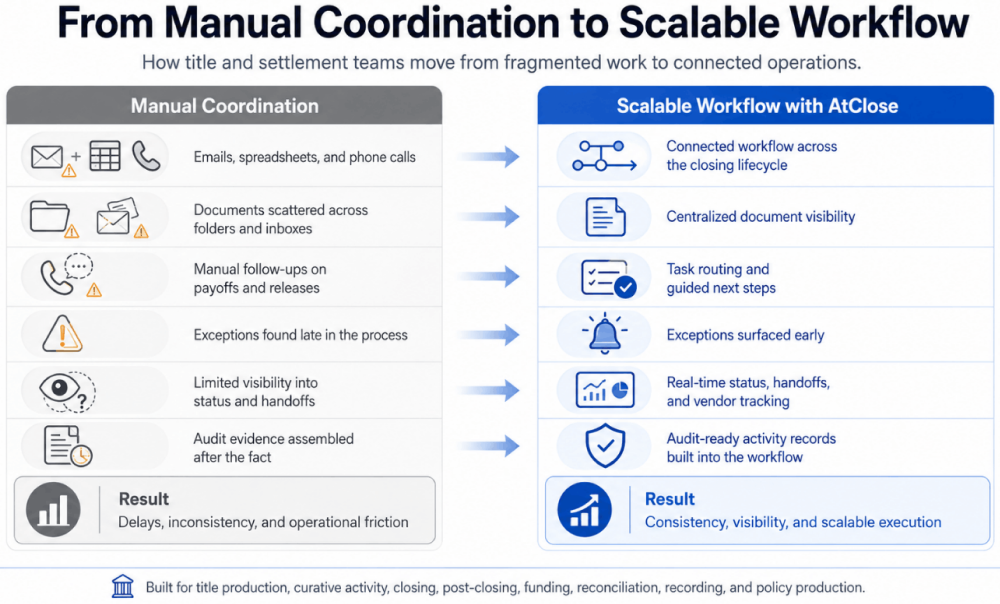
When this work is managed through scattered emails, spreadsheets, manual task lists, or disconnected systems, small delays multiply. A missing release, late payoff, unresolved exception, or unanswered vendor request can hold up the closing.

This is where automation can help, but only if it supports the real workflow. Basic task tracking is useful, but title teams need more than a place to store documents. They need systems that help route work, surface exceptions, standardize steps, monitor handoffs, and preserve audit-ready records as the file moves forward.


manual


The AtClose Perspective

AtClose is designed around this operating reality. Title production is complex, document-heavy, and coordination-intensive. Human expertise remains essential, but teams should not have to spend so much time chasing updates, finding documents, manually routing tasks, or reconstructing file activity after the fact.

By supporting workflows across title production, curative activity, vendor follow-up, closing, post-closing, funding, reconciliation, recording, and policy production, AtClose helps title and settlement teams manage complexity with greater visibility and consistency.

The future of title production will not be defined by digitization alone. It will be defined by how well agencies can combine human expertise with scalable workflows.

ALTA’s study makes the real work behind every closing clear. The opportunity now is to protect that expertise, reduce administrative friction, and give title professionals the operational support they need to move files confidently toward close.

case study
Case Study

Enterprise Digital Transformation: National Expansion via Unified Platform

short desc
Scale national title operations with a unified platform that slashes costs and accelerates onboarding.

Customer

A large-scale title and settlement services provider seeking aggressive national expansion through modernized, enterprise-grade technology.

Challenge

The client’s growth ambitions were severely restricted by legacy title systems that lacked the necessary performance and scalability for a national footprint. These outdated platforms created fragmented workflows across different regions, leading to operational silos and inconsistent service delivery that hindered the company's ability to compete effectively in a multi-state market.

Beyond technical limitations, the business was constrained by a traditional vendor-dependency model that limited their control over their own technological roadmap. This lack of flexibility made it difficult to adapt to evolving compliance needs and cost optimization requirements, creating a bottleneck for sustainable innovation and long-term expansion.

AtClose Solution

The transformation began with a shift to a strategic partnership model where Visionet provided the client with source code ownership to ensure operational independence. The AtClose platform was implemented as a flexible and extensible foundation, specifically customized to support four interconnected business channels through unified but highly configurable workflows.

This solution integrated data-driven vendor management and analytics-based order management to streamline national operations. By aligning technology decisions with specific business outcomes and cost-optimization goals, the platform provided the scalability required to manage increased volume while maintaining strict operational control.

Business Benefits

The implementation of AtClose delivered immediate financial and operational gains, including an 18% reduction in operating costs and a 21% improvement in overall productivity. Additionally, the use of data-driven analytics in vendor management helped drive down third-party costs by a further 7%.

Market agility was significantly enhanced, as the time required to onboard new states, lenders, and partners was reduced by nearly 60%. This accelerated expansion capability allowed the client to move away from legacy constraints and achieve faster revenue growth through a truly scalable, enterprise-wide digital infrastructure.
 

blog4
Blogs

From Manual to Intelligent: The Evolution of Title & Settlement Workflows

short desc
Modernize fragmented title workflows by embedding AI intelligence directly into every stage of closing.

The Growing Complexity of Title & Closing Operations

Title and Settlement operations have always required precision, coordination, and deep domain expertise. However, over the past few years, the complexity of these operations has increased significantly. Evolving underwriting guidelines, tighter regulatory expectations, and rising transaction volumes have placed additional pressure on teams responsible for managing the closing lifecycle.

At every stage, starting from order intake and title production to funding, reconciliation, and policy issuance, teams are required to process large volumes of documents, verify data across multiple systems, and ensure compliance with both internal and external requirements. These are not isolated steps; they are interconnected activities where even a small discrepancy can create downstream delays or risks.

Despite this growing complexity, many Title and Settlement workflows still rely heavily on manual checks, individual expertise, and fragmented systems. Teams often move between tools to validate information, interpret underwriting requirements, and resolve exceptions. As order volumes increase, this approach becomes increasingly difficult to sustain. Manual processes introduce delays, increase operational risk, and make it challenging for organizations to scale without proportionally increasing headcount.

The result is a workflow that is operationally intensive and reactive, where issues are often identified late in the process rather than proactively managed.

How AI is Transforming Title & Closing Workflows

A meaningful shift is now underway as artificial intelligence is embedded directly into the title and closing lifecycle. Instead of functioning as a standalone tool, AI is increasingly becoming part of how work gets done, supporting teams at each stage of the order journey.

At a high level, AI in title and settlement operations can be understood across five key areas of impact:

  • Guidance and Decision Support
    AI-powered help agents provide instant, context-aware guidance by referencing underwriting guidelines and internal procedures. This reduces dependency on tribal knowledge and ensures that teams can make consistent decisions, even in complex scenarios.
     
  • Document Intelligence and Automation
    AI systems can scan, categorize, and organize documents automatically, significantly reducing the need for manual data entry and document handling. This not only improves speed but also minimizes errors that typically occur during manual processing.
     
  • Embedded Quality Control
    Instead of relying on post-process audits, AI enables automated quality control checks that apply underwriting rules continuously. Potential issues can be identified early in the workflow, reducing the cost and effort of late-stage corrections.
     
  • Financial Reconciliation Intelligence
    AI-driven reconciliation capabilities help detect discrepancies such as funding mismatches or book-to-bank outages. More importantly, they can suggest corrective actions, enabling teams to resolve issues faster and with greater confidence.
     
  • Continuous Risk and Compliance Monitoring
    AI can monitor transactions in real time for fraud signals and compliance risks. By continuously evaluating orders against predefined criteria, it strengthens oversight without slowing down the workflow.
     

The Benefits of AI-Driven Title Operations

Embedding AI into Title and Settlement workflows fundamentally changes how operations are executed. Instead of relying on manual effort to manage complexity, teams can operate within a system that continuously supports, validates, and monitors their work.

This shift leads to several tangible outcomes. Manual effort is reduced as repetitive tasks such as document handling, validation, and reconciliation are automated. Issues are identified earlier in the process, allowing teams to address them before they escalate into delays or compliance risks. At the same time, continuous monitoring ensures that oversight is maintained without introducing additional friction into the workflow.

Perhaps most importantly, AI enables teams to focus on higher-value activities that require human judgment, such as exception handling, customer coordination, and decision-making in complex scenarios. Rather than replacing expertise, it amplifies it.

Platforms like AtClose enable this transition by embedding intelligence directly into the operational lifecycle, bringing together guidance, automation, and monitoring within a unified workflow. The result is not just improved efficiency, but a more structured and reliable closing process.

Closing Thought

As title and settlement operations continue to grow in complexity, the limitations of manual and fragmented workflows become increasingly evident. AI offers a way to move beyond these constraints: not by changing the nature of the work, but by transforming how it is executed.

Organizations that embrace this shift will be better positioned to scale, manage risk, and deliver consistent outcomes in an environment where precision and timing are critical.
 

blog3
Blogs

Multi-Tab Madness Eliminated: AtClose eliminates the "Toggle Tax" for Good

short desc
Eliminate the toggle tax by putting your agency’s collective tribal knowledge into every workflow.

It’s 4:30 PM on a Friday. You have three files scheduled for a dry funding, and a complex vesting issue pops up on a fourth. You know the answer is buried somewhere - either in a 40-page underwriting manual from three years ago, a static PDF of your company’s SOPs, or as expertise within the internal team.

But they are on a closing call. So, you wait. You dig through folders. Or, worst of all, you guess.

In the world of title and settlement, only property records are not managed, there is an overwhelming mountain of documentation and knowledge to be stored. While the industry has successfully digitized the files themselves, the knowledge required to process them remains frustratingly manual and fragmented.

The Knowledge Gap: Why "Static" Doesn't Work Anymore

Title agencies operate in a high-volume, time-sensitive environment. Teams juggle time-sensitive TRID compliance, varying state-specific requirements, and the constant evolution of underwriting guidelines.

The challenge isn’t a lack of information but the accessibility of it. Most agencies rely on a "Knowledge Repository" that is often just a graveyard of PDFs and Word docs. When a team member needs to verify a specific requirement for a Power of Attorney or a subordinate lien, they face the "Toggle Tax". constantly switching between their production system, email, and a shared drive.

This creates a culture of dependency. Junior staff spend their day asking "quick questions," while senior staff spend their time answering them instead of clearing high-level title curative issues. This bottleneck slows down the file, breeds inconsistency, and creates unnecessary friction in the onboarding process.

5 Ways the AtClose AI Agent Helps Teams Operate Better

This is where the AtClose AI Help Agent steps in, not as a replacement for your team’s expertise, but as a force multiplier that puts your agency’s collective brain power directly into the active workflow.

1. Eliminating the "Toggle Tax"

Every time an employee leaves their core workflow to hunt for a procedure, they lose focus. It’s a cognitive drain. With the AI Agent, staff can ask questions directly within the AtClose interface. By removing the need to minimize screens or dig through browser tabs, the answer meets the user exactly where the work is happening.

2. Standardizing Tribal Knowledge

Every agency has that one person who knows exactly how the owner wants a specific endorsement handled. But if that person is unavailable, progress stalls. The AtClose AI Agent digitizes that "tribal knowledge." By indexing your specific internal SOPs, the AI ensures that the expert way becomes the standard way for the entire team, 24/7.

3. Faster New Hire Onboarding

Onboarding a new title processor usually involves weeks of shadowing and repetitive questions. With AI-powered guidance, junior staff have a "digital mentor" that provides instant, accurate answers. This allows them to resolve routine procedural queries independently, reaching full productivity much faster than traditional training methods allow.

4. Real-Time Guideline Adherence

Underwriting bulletins and state laws are moving targets. When you update your documentation in the backend, the AI Agent reflects those changes immediately. This ensures your team isn't accidentally referencing an outdated memo from last year, significantly reducing the risk of post-closing claims or compliance errors.

5. Reducing Cognitive Fatigue

Decision fatigue is real in high-volume title work. Choosing between different ways to phrase a curative requirement or checking a fee schedule takes a mental toll. By removing the manual "search-and-verify" labor, AI allows your team to focus their mental energy on high-value problem solving and client relationships.

Bringing Clarity to Title Operations

The future of title operations isn't about working harder, but reducing the friction between a question and its answer. When your team can move faster and make more confident decisions without the constant interruption of manual document searches, the entire business scales.

AtClose AI is the solution that connects your team directly to the information they need, exactly when they need it. It turns your static manuals into a dynamic asset, allowing you to close files with more speed and less stress.

Stop digging through manuals and start closing with total clarity. Explore AtClose today.

blog2
Blogs

Going from "Where is that PDF?" to "Clear to Close" faster: Streamline these 6 tasks.

short desc
Scale your title agency by automating routine manual tasks that interrupt your team's expertise.

Imagine a Senior Closer, Sarah. She’s juggling three high-stakes residential closings scheduled for 2:00 PM. Instead of finalizing the settlement statements, she’s spent the last forty minutes frantically toggling between three browser tabs and a 40-page PDF manual just to verify a specific lender’s updated notary requirement. Meanwhile, a new processor is standing at her desk asking which "standard" SOP applies to a mobile home title in a different county.

None of these moments look serious on their own. But inside a busy title operation, they happen constantly.

As file volumes rise and lender expectations become more demanding, title teams are being asked to move faster while maintaining accuracy, compliance, and consistency. The challenge is that many agencies are still carrying too much manual operational work inside the daily flow of every file.

Why routine work creates real operational drag

Teams are managing file intake, title production, internal approvals, lender-specific requirements, document review, compliance checks, vendor coordination, and post-close readiness often across multiple systems and handoffs. The problem lies around both complexity and repetition.

From the outside, title operations look like a document business. From the inside, it’s a game of logistical chess. When routine tasks absorb 60% of a team's day, they lose the capacity for work that actually requires human judgment, such as resolving complex curative issues or managing client relationships.

To scale a B2B title agency in 2026, you have to eliminate the "manual busywork" that keeps interrupting your expertise. Here are the six routine bottlenecks you should streamline immediately - 

1. Order entry

Re-typing borrower details and property data from a PDF into your production system is not only tedious, but a liability. Every manual entry is an opportunity for a typo to surface as a costly error at the closing table.

2. Searching SOPs and guidelines

Title teams regularly need quick answers to process questions: Which workflow applies? What does this client require? What is the correct next step?

When those answers live inside PDFs, shared folders, or long procedural manuals, even simple clarifications can interrupt file movement longer than they should.

3. Answering repetitive process questions

In many operations, experienced staff become the default source for basic workflow guidance. That creates dependency.

When senior team members are repeatedly pulled into routine questions, they lose time that should be spent on escalations, exception management, and more complex decisions. It also makes onboarding slower for newer employees.

4. Compliance checks

Manual compliance checks remain a major operational burden. Teams still review files against underwriting requirements, internal procedures, and client-specific rules to confirm readiness.

This work is essential, but when it is done manually across every file, consistency becomes harder to maintain as volume increases.

5. Document identification

Before a team can act on a file, someone often has to determine what is actually in it. That means manually reviewing stacks of commitments, deeds, affidavits, lender documents, and supporting forms.

It is familiar work, but it is also time-intensive. The “stare-and-sort” process may feel normal, yet it becomes increasingly difficult to scale.

6. Information lookups across systems

Many title professionals still move between platforms, inboxes, document repositories, and internal references just to confirm a file detail or process status.

That context-switching may seem minor at the moment, but across hundreds or thousands of files, it creates measurable workflow drag.

The Goal is Human Expertise, Minus the Interruptions

Let’s be clear. AI for title companies isn't about replacing the experts, It’s about removing the repetitive “clutter” that keeps interrupting them.

Think of AtClose AI as the ultimate workflow filter. By automating routine steps and surfacing operational knowledge directly inside your team’s existing flow of work, we help title teams stop the endless cycle of searching, checking, and re-entering data across five different systems.

When you turn your static manuals into dynamic assets, the benefits show up on your bottom line immediately:

  • Scavenger hunts removed forever: No more digging through folders for a single notary rule.
  • The "One Version of Truth": Procedural decisions become consistent across the entire team, every time.
  • Onboarding scales faster: New hires get up to speed in days, not months, without shadowing your best closers.
  • Frictionless Handoffs: Files move through the pipeline without getting stuck in a "manual review" purgatory.

When the busywork is off the plate, your title professionals can finally focus on what they do best: resolving complex curative issues, building client relationships, and moving transactions forward with total control.

Bringing Clarity to Title Operations

The goal of AI in title operations isn't to replace the experts; it’s to remove the repetitive work that keeps interrupting them.

AtClose AI connects your team directly to the information they need, exactly when they need it. By turning static manuals into dynamic assets and automating the "stare-and-sort" tasks, we help agencies move faster and make more confident decisions.

The result? Less time searching, fewer manual bottlenecks, and a team that can finally focus on what matters most: closing.

Manual busywork standing in the way of your agency's growth? See how AtClose can automate your routine tasks and give your team the space to scale.

blog1
Blogs

From Reactive to Proactive: AI in Title & Closing Risk Management

short desc
Shift from manual checks to proactive AI monitoring for total closing risk management oversight.

The Risk Challenge in Title & Closing Operations

Risk is inherent to every stage of the title and settlement process. From verifying documents and ensuring compliance to reconciling funds and issuing policies, each step introduces potential points of failure. What makes this particularly challenging is not just the number of checkpoints, but the interdependence between them. A missed detail in document preparation can cascade into funding discrepancies, compliance issues, or delays at recording.

In most organizations, risk management still relies heavily on manual review and individual expertise. Teams are expected to validate large volumes of documents, cross-check data across systems, and interpret underwriting requirements, and all this while working within tight timelines. As order volumes increase and underwriting guidelines become more complex, maintaining consistency in risk identification becomes increasingly difficult.

This often results in a reactive approach to risk. Issues such as missing documentation, data mismatches, compliance gaps, or even potential fraud signals are frequently identified late in the process. By that point, the cost of correction is higher, both in terms of time and operational effort. Delays, rework, and exposure to compliance risks become harder to avoid.

The core challenge is not simply the presence of risk, but the inability to detect and manage it continuously throughout the closing lifecycle.

How AI Is Transforming Risk Management Across the Closing Lifecycle

A more effective approach is emerging, one where risk is not managed at isolated checkpoints, but continuously monitored and evaluated as the order progresses. This is where AI is beginning to reshape title and settlement operations.

Instead of adding another layer of review, AI enables embedded risk intelligence across the workflow. This can be understood through five interconnected capabilities that map directly to the closing lifecycle:

At the foundation is continuous order monitoring, where changes in order data are tracked in real time. Rather than waiting for a review stage, the system surfaces potential risks as they emerge, ensuring that issues do not go unnoticed between handoffs.

Building on this, automated quality control checks apply underwriting guidelines both before and after closing. These checks are consistent and repeatable, reducing reliance on manual validation while ensuring that critical requirements are not missed.

Alongside quality control, fraud detection mechanisms analyze patterns and inconsistencies within order data. By identifying conflicting or unusual information early, teams are better equipped to investigate and resolve potential concerns before they escalate.

At the same time, compliance monitoring ensures that orders are continuously evaluated against regulatory and internal requirements. This is particularly important in environments where compliance expectations are evolving and difficult to track manually across multiple stages.

Finally, risk identification driven by underwriting logic helps prioritize attention where it is needed most. Orders that exhibit elevated risk characteristics can be flagged for additional due diligence, allowing teams to focus their expertise on the transactions that require it.

The Benefits of AI-Driven Risk Management in Closing Operations

Embedding AI-driven risk monitoring within the operational workflow fundamentally changes how title and settlement teams manage risk. Instead of manually reviewing every file with equal intensity, teams can rely on systems that continuously evaluate orders and surface potential issues in real time.

This allows organizations to reduce manual oversight without compromising control. Issues are identified earlier, when they are easier and less costly to resolve. Compliance is strengthened through consistent application of underwriting and regulatory rules.

At the same time, operational efficiency improves, as teams are no longer required to spend time on repetitive validation tasks.

Perhaps the most important shift is in how attention is allocated. Rather than spreading effort thinly across all transactions, teams can focus on high-risk orders that require deeper investigation and judgment. This leads to better outcomes without increasing workload.

Platforms like AtClose are enabling this transition by embedding risk intelligence directly into the closing lifecycle. By combining continuous monitoring, automated checks, and real-time insights, they help organizations move from a reactive model of risk management to one that is proactive and structured.

Closing Thought

As title and settlement operations continue to grow in complexity, risk management can no longer depend solely on manual processes and periodic checks. A more continuous, integrated approach is required, one that actually aligns with how the closing lifecycle actually functions.

AI makes this possible by transforming risk management from a checkpoint activity into an ongoing capability. Organizations that adopt this approach will be better equipped to reduce risk, improve efficiency, and deliver more predictable closing outcomes.
 

Whitepapers

AtClose Exchange - The Unified End-to-End Digital Lending Solution

Download White Paper

Eliminating
Blogs

How AtClose AI Is Eliminating Bottlenecks in the Mortgage Closing Process

short desc
The mortgage industry is entering its next growth cycle, but the closing process is still catching up.

How AtClose AI Is Eliminating Bottlenecks in the Mortgage Closing Process

The mortgage industry is entering its next growth cycle, but the closing process is still catching up.

According to the Mortgage Bankers Association (MBA), total single-family mortgage origination volume is projected to reach $2.2 trillion in 2026, representing meaningful growth in both purchase and refinance activity.

For lenders, title companies, and settlement agents, rising volume should be welcome news. But it also exposes a hard reality: the closing process remains structurally fragile. Despite years of digital investment, the average mortgage closing still takes roughly 40 to 45 days across the industry.

Manual handoffs, document-heavy workflows, and exception-driven processes continue to slow files, strain teams, and introduce risk. At the same time, borrower expectations have shifted sharply toward faster, more transparent, and more digital experiences.

In this environment, AI in mortgage closing is no longer a future concept. It is becoming essential infrastructure, required to scale operations without scaling risk, cost, or headcount.

AtClose is leading this transition by moving beyond basic automation toward workflow intelligence: AI embedded directly into the closing lifecycle to guide decisions, reduce friction, and keep files moving predictably from order intake to post-closing. Below are the most persistent bottlenecks in today's mortgage closing process, and how AI-native systems like AtClose are eliminating them.

1. The Knowledge Gap: Underwriting & Process Complexity

  • The Problem: Settlement teams constantly context-switch - searching static PDFs, emails, and client-specific instructions to understand underwriting rules, state requirements, and lender guidelines. This slows productivity and increases compliance risk, especially as volumes rise.

  • How AtClose Helps: The AtClose AI Help Agent acts as an on-screen subject-matter expert. Instead of generic answers, it references real underwriting guidelines and operational documents in real time - delivering file-specific guidance that helps teams follow the right steps at the right moment.

2. The Data Entry Trap: Document Indexing & Intake

  • The Problem: A single closing package can span hundreds of pages. Manually reviewing, classifying, and re-keying data from these documents remains one of the largest sources of clerical drag, rework, and human error in title and settlement operations.

  • How AtClose Helps: AI-driven Document Intelligence automatically scans, categorizes, and extracts key data from title commitments, closing packages, and recorded documents. Instead of slowing files down, documents become structured inputs that surface changes, discrepancies, and risks as soon as they appear.

3. The Quality Control Crisis

  • The Problem: Traditional quality control is often reactive. Errors are discovered late – during final review or just before funding, leading to last-minute fixes, delayed closings, and frustrated borrowers.

  • How AtClose Helps: Automated Quality Control shifts QC earlier in the lifecycle. By continuously applying client-specific rules and underwriting requirements, AtClose identifies issues during production - not at the finish line, allowing teams to resolve them long before they impact closing timelines.

4. Rigid Workflows & Routing Bottlenecks

  • The Problem: Not all files are created equal. Yet many title systems force standard refinances and complex transactions through the same workflows, creating bottlenecks and manual triage that slow down the entire operation.

  • How AtClose Helps: AI-driven workflow orchestration evaluates incoming data and dynamically routes files based on complexity, risk, and client guidelines. High-priority or exception-heavy files get the attention they need — without manual intervention — while simpler files move faster through the system.

5. Post-Closing Reconciliation & Funding Delays

  • The Problem: Post-closing reconciliation is meticulous, high-stakes work. Funding outages, wire discrepancies, and accounting mismatches can sit unresolved for days, tying up capital and creating downstream stress.

  • How AtClose Helps: AI reconciliation agents automatically review funding and book-to-bank data, identify discrepancies, and surface the root cause, generating adjustment guidance and alerts that accelerate resolution instead of prolonging uncertainty.

6. Fraud Is Becoming Faster and More Sophisticated

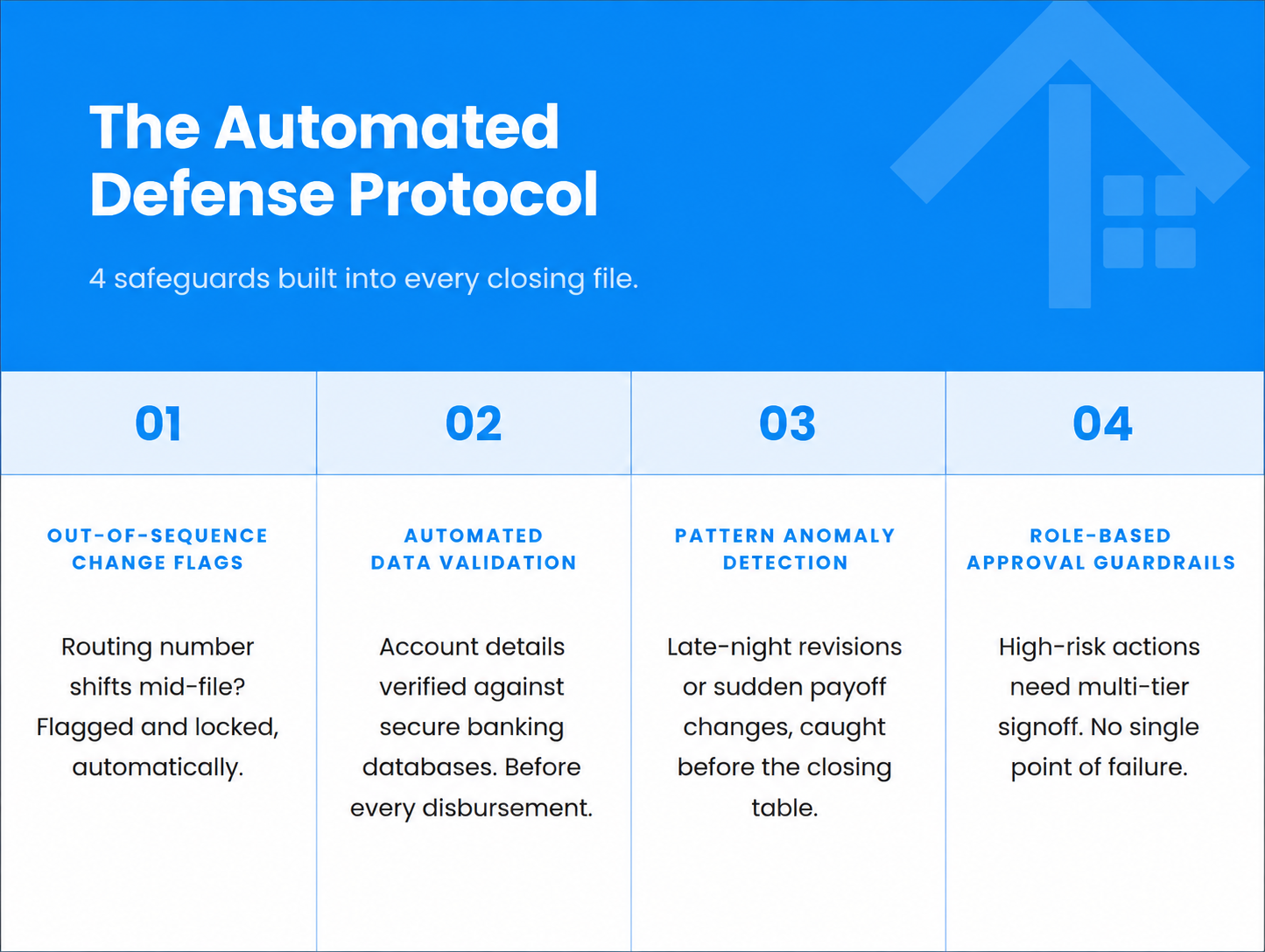
  • The Problem: Mortgage and real estate transactions have become prime targets for wire fraud and identity-based attacks. As fraud techniques grow more sophisticated, manual spot-checks and static controls struggle to keep pace.

  • How AtClose Helps: Mortgage fraud detection AI operates as a continuous observer throughout the life of the file - monitoring for anomalous changes in data, behavior, and documents. Instead of reacting after the fact, teams gain earlier signals to intervene before fraud reaches funding.

7. Regulatory & Compliance Overload

  • The Problem: Compliance requirements evolve constantly. Manual checklists and one-time updates don't scale and missing a regulatory change can lead to audit findings, fines, or loss of lender trust.

  • How AtClose Helps: Compliance and regulatory AI continuously evaluates active files against current standards, creating an always-on safety net that flags potential issues before they become violations.

8. Elevated Risk Is a Pattern, Not a Single Red Flag

  • The Problem: High-risk files rarely announce themselves through one obvious issue. Risk emerges when multiple small signals intersect across documents, timelines, and exceptions.

  • How AtClose Helps: AtClose's risk assessment engine analyzes these intersections, identifying elevated-risk files early and directing attention where additional due diligence matters most — before small issues compound into major delays.

The Way Forward: From "Digital" to "Intelligent" Closings

Most closing bottlenecks are not caused by lack of effort; they are structural. The industry is still trying to manage modern volume with workflows designed for a different era.

While digital closing tools are now widely available, adoption data shows that transformation remains incomplete. The next phase is not just about going digital - it's about making closings intelligent.

By embedding AI directly into the file lifecycle, AtClose enables settlement teams to reduce manual work, surface exceptions earlier, and deliver predictable, scalable closings, even as volumes rise.

Ready to see how workflow intelligence changes the closing experience?

Let's talk.